An interview with Ralf Hutter
Ralf Hutter first met Florian Schneider in the Dusseldorf Academy, Germany in 1968, where courses were being held in musical improvisation. From this essentially classical background they teamed up to try their newly acquired skills with experiments in electronic sound that began by simply using amplifiers, echo machines and feedback effects.
“Not only were we interested in. Musique Concrete but also in playing organ tone clusters and flute feedback sounds that added variety to the repeated note sequences that we recorded and mixed on tape. Then we used several acoustic drummers as we turned our attention to more rhythmic music, and soon found that amplifying drums with contact mics was desirable for us but not readily accepted by the players.”
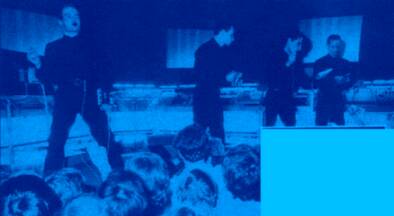 “We started off ‘Kling Klang’ studio in 1970, which really marked the beginning of Kraftwerk. The studio was, in fact, just an empty room in a workshop premises that was a part of an industrial area in Dusseldorf. We fitted sound isolation material into the 6Osq metre room, and we now use other adjoining roams where we make instruments. When we first moved in, we started recording with stereo tape machines and cassette recorders in preparation for our first record. The. master tapes were then taken to the recording studio for final mixdown. This allowed us to be ‘self producing’ at the time as far as we could with our own limited resources, so we did another three LPs in this way.”
Don’t forget in those days successful musicians used important producers to promote and launch their records, but we took on every aspect of the production ourselves” Ralf commented. “It’s very encouraging in England today to see people bringing out their record/cassette labels. From the start we used cassettes for recording ‘in the field’ and mixed these sounds with our instruments in the studio.
“It’s be en quite a common thing for groups to have their own ‘home studios’ in Germany with the emphasis very much on ‘do-it-yourself’ activities. We made our own record covers by taking Polaroid pictures and designing the artwork, and did our own management. In 1971 Kraftwerk was still without a drummer, so I bought a cheap drum machine giving some preset dance rhythms. By changing the basic sounds with tape echo and filtering we made the rhythm tracks for our second album. 0ur instrumental sounds came from home-made oscillators and an old Hammond organ that gave us varied tonal harmonies with its drawbars. We manipulated the tapes at different speeds for further effects.
 “Commercial synthesisers came fairly late into Germany and it was not until the third album that we started to use them. By that time, Wolfgang Flur had joined us to play a custom built drum system and was our first percussion player to accept electronically produced drums.
“Electronic music was quite new as a musical medium in the early ’70’s, of course, and many people were just starting, like the Can group in Cologne.
“I think we were one of the first groups to have an electric drummer with Wolfgang Flur. As well as the custom drum console, we now have two sets of drums that consist of six metal pads triggered by metal sticks on contact. These are not touch sensitive, so accents and dynamics come from separate volume foot pedals. Sometimes we link one or more pedals to change other parameters, such as tone or pitch.”
A year later Karl Bartos became the fourth Kraftwerk musician because he also believed that music could be made satisfactorily through entirely electronic means.
“We feel music is more a product of the imagination and the instruments are made as a result of everything we do. We don’t see ourselves as specific instrumentalists – I am not just a keyboard player, nor is Wolfgang simply a drummer, this is too limiting for each player who has developed skills in making harmonies and melodies as well as rhythms.”
The Kling Klang studio equipment continued to be designed by all four musicians and since their knowledge of electronics was limited, they employed a full time engineer to make and service equipment as well as a mathematician to devise the computer programs.
“Our daily schedule of work lasts some 8-10 hours in the studio. We don’t regard ourselves just as musicians but as Musik-Arbeiter (musical workers), and we designed and built up our complete portable studio set that includes the stage backdrops, curtains, lighting, frames, staging and stereo PA system as well as the instrument equipment stands. Multi-wired cable looms are used for quick dismantling of each section of the movable instrument frames. The players stand on metal box staging that hides the mass of wiring. Fortunately, we are all about the same stature, so each of the four players sections of the instrument gear is built to be suitable for any of us. All the instrument racks are standard 19″ width and pack away into cases for transit.”
In Performance
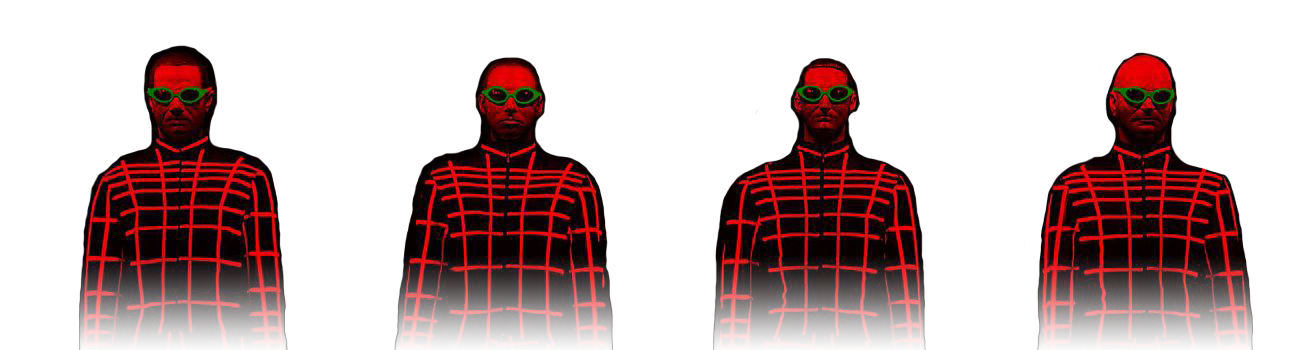
I asked Ralf about their style of performance. “So many people move or even jump around on stage these days and it’s important for our music that we do not do this – our rather static performance is also necessary for emphasising the ‘robotic’ aspect of our music (in the new ‘Computer World’ LP).
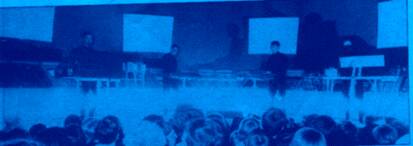
“The physical layout of the equipment, besides being functional, was to imply the idea of the ‘man man machine machine’ which we’ve always talked about – that the music does not become dominated by one or the other. For example, some people perform with their musical machines built up high around them in an impressive way – we prefer the low profile image, bringing man and machine together in a ‘friendly partnership’ of musical creation.
“We have been building the set for the last three years (since the ‘Man Machine’ album), whilst composing the music and and preparing the video graphics. Most of the instruments were obtained in previous years but they were wired in a more typical electronic music studio fashion. Besides looking rather messy, the earlier layout caused problems in transport and hours of rewiring for each performance. It actually takes two hours at most to install or dismantle the new set. We always bring our own German stage crew but of course other people often help in the local halls. To minimise component failure and rough handling, we use industrial high spec./heavy duty devices in the equipment.”
It is very easy for audiences to be ‘fooled’ into thinking that electronic music groups play all the music when in fact, much if not all the music can be pre-recorded. In this way, the live performance can be made to sound like the artists’ LP version. A most important point here is that Kraftwerk DO play most pieces completely LIVE and EVERY item on their futuristic equipment consoles is usable in performance. On both sides of the large stage set are the PA stacks which deliver up to 12K watts output. Their grey cabinet, colour was deliberate to match the set and the group’s own image in ‘sombre’ black. When I attended Kraftwerk’s concert at the Hammersmith Palais in London, the sound was clear without distortion, even with the computer speech.
Equipment
 The instrument and equipment. used by the players contain items collected since 1971. The four large video screens were made by Sony in Japan and the recent UK tour was delayed because it took much longer than expected to compile the video film and rehearse with the music and video in sync.
“The paint was literally just drying off as the items were packed,” remarked Ralf, “and just in case any problems were encountered, two engineers started off our tour through. Southern Europe.”
The video screens were chosen to compliment the four players who have their own personal monitor screen on their part of the main consoles. The video programmes all appear at the same time on each screen and consist of film and microcomputer material. These are not exactly synchronised to the music but simply start a new sequence for each piece. Occasionally the fluorescent strip lights, overhead spots or floor strobes were used, while the screens had a ‘white snow’ blank transmission picture. Some of the computer programs were made on Atari and Texas microprocessors and Ralf plans to install a keyboard terminal beside each TV monitor for a player to select and alter the display in time to the music.
“Everybody seems to limit themselves by saying ‘I’m an instrument player’ but we like to ‘play pictures’ as well as share the instruments available. Gunter Spachtholz is the video and lighting engineer handling all the visuals and he sits on the left hand side of the stage (viewed from the audience). On the other side of the performers is the sound engineer (we call him our dB man!), Joachim Dehmann. Although. he makes the final balance of the total sound output, each player mixes his instruments separately from up to eight sound sources.”
The Robots
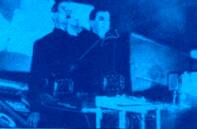
“We like to portray the things we do on a day-to-day basis in our music other people might be fascinated by space flights to the moon and so on. We did try a space lab kind of set once, but always prefer now to relate to everyday technology, such as cars, trains and other human-controlled machines.
“Our ‘trip’ for these current performances is based on robots. The idea of the robot came from a tour that covered 65 places in America. As a result we started to become automatic and ‘robotic’ ourselves – even new pieces were written in 5-10 minutes (one evening in a discotheque I wrote ‘Showroom Dummies’ like that). We were intrigued that the Russian word ‘Robotnic’ means ‘Worker’ and so much related to our ideas.
“We generally keep our audience contact to a metaphysical level really because we have little time to look around – although we are very aware of their response. The only exception is with ‘Pocket Calculator’.” Here, Ralf had a mini -synth instrument, Karl and Florian had a calculator each and Wolfgang provided the drum taps. This current single for the group was certainly brought to life on stage and promoted audience participation in playing the extra instruments. These were connected by signal cable to the consoles (even though they could have used radio control) because it gave the feeling of being linked like a robot to its main control machine. “Again, we found the instruments in a department store last Christmas, so we took everyday items into our music from ‘street level’!
“We both agreed the way musical equipment is designed in the future could be as an extension from the human being, with suitable feedback between machine and man The emphasis on keyboards could turn to instruments, controlled by some part of the body, using piezo pick-ups, special electrodes and heat sensitive elements. Even 10 years ago, I used to rub a contact mic on my clothes and skin to produce different sounds that would change at each performance.”
Backgrounds
Ralph is 34 with the others also in the late 20’s/early 30’s. None of the group are married and Karl, like Ralf and Florian has a classical music background. Wolfgang’s musical experience prior to Kraftwerk was in popular music. Ralf originally studied as an architect and certainly none of the group intended to become professional musicians.
“We like the audience to dance and move to our music – especially as in recent years people tended towards a more concert-listener approach, even more so with electronic music. Electro-music is a much suitable title than electronic music for the way music in general is going. The instruments of electra-music help to liberate people’s creativity, allowing individuals to use studio technology in their home for almost any sound they want.
“When we select an instrument sound, we don’t worry if, for example, the strings are not authentic – we simply take the sounds we like!
“On stage we use sheet music, graphic diagrams and settings which cue us in our pieces to switch on or off devices and adjust instruments, as well as reminding us of note sequences, lead, harmony lines and rhythmic structures.
“The philosophy I have is that the music becomes so complex that it has to be written down. I have this tendency that if I can’t remember it from memory then maybe that music is not worth doing. I tend to play more like a busking musician and my rather simplistic view is that if I forget it then it’s worth forgetting so I play something else!”
Kraftwerk’s latest “Computer World” was prepared over the- last 3 years along with the present Kling Klang studio.
“The pieces in many ways ‘compose themselves’ by us finding sounds from experimenting with interfacing and settings. During the week, we work from 5 p.m. until 1 or 2 at night. During other times in the day we do the administration for Kraftwerk and liase with our engineers and visitors.”
Kling Klang
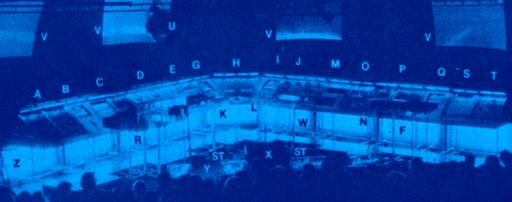
The Kling Klang studio arrangement gives an intriguing insight into music of the future. Ralf and I the layout in the labelled photograph and discussed the equipment working from left to right (from Ralf to Florian). The letters in the following text relate to the locations on the picture.
A First, there are two analogue sequencers which will produce up to 64 notes. The many rows of switches have ‘in, shift and stop’ settings for bigger, rest and reset points, as well as pitch control. The sequence can run as two x 32 in parallel or 1 x 64 in series LED indicators can be clearly seen from the audience during operation. The triggers can be outputted wherever Ralf desires, generally to the console instruments (except Karl’s who prefers to play manual bass lines).
So here is the secret of Kraftwerk’s superb synchronisation throughout their performance. ‘Remember, we have been playing this kind of synchronised music for about 10 years. To play along with machines is very difficult – a lot of people speed up or slow down when doing it. Our ‘dialogue’ with the machines is to choose whenever we want the machine or human pulse. Although we don’t yet have the perfect set-up, the friendship or inter-relationship we create with the machines makes them an extension of the musician. If one instrument breaks down we are still able to continue, and when we finish our current series of tours we’ll be modifying the set still further.”
Several master clocks are positioned around the console so that any player can be selecting a tempo for the next piece. This explains the short gap between numbers – “It could be even shorter but we are a little nervous. sometimes! We can also trigger other synthesisers off stage and the clock times are set via a digital display and key pad.”
B Ralf’s TV monitor and telephone communication to engineers.
C The Roland Micro-Composer (with expanded memory) plus a bank of-switches for routing signals. “The composer can be used for extra tracks in one or two pieces or as the time clock in performance, although we prefer to use it when we are at home for trying out sequence combinations. This is much easier than using the analogue sequencers but it still takes a fair amount of time to set up.”
D The Eventide Digital Delay and Flanger with a small stereo mixer. Panning of sounds can be done by the players mixers or by the sound engineer. “We are not the biggest fans of panning!” comments Ralf. “We think stereo is a ‘privileged sound’ since only those that sit in the middle hear it properly, and so we are happier to use a mono output that has plenty of depth. Electronic Reverberation is not used very much in performance because most venues have enough (or too much already.”
Both Ralf and Florian use headsets. Ralf does the ‘straight’ vocals, often shielding the mic with his hand to avoid feedback and increase bass volume Florian’s mic feeds the vocoder and this adds subtle changes to Ralf’s voice and provides extra effects.
R “I am playing three keyboard instruments stacked on my console: a special light-disc instrument from Florida for mono choir sounds, with the Polymoog and Minimoog synthesisers. We all have 4 foot pedals under our front consoles for volume and/or effect control.”
K This is Karl’s keyboard – specially made in Italy to replace Korg’s keyboard controller, which operates the Korg PS-3300 polyphonic synthesiser set in E console. One of its special features for us is its ability to merge harmonic with ‘non-related’ overtones and its parameters stretch attack and decay times to their limits. In E there are also a tuning device, volts/amps meters for checking power supplies and graphic equalisers. Incidentally, LEDs on the keyboard console panel show notes being played to the audience.
G Karl’s TV monitor.
H Ventilation grilles in corner section linking the two straight console rows.
I Wolfgang’s TV monitor.
J The custom-built drum consoles. Here are the electronics for the two drum controllers containing 6 metal pads mounted on stands L Also various filtering devices plus a Syndrum unit. One drum pad is played by Karl occasionally and the other by Wolfgang. M Next come some more equalisers including parametric types, filters, mixer rack, Eventide Harmoniser and Digital Delay, and Limiter/compressors.
W Wolfgang’s console contains the special drum machine built by Kraftwerk’s engineer. There are 6 rows of switches, each row having its own drum sound that can be pulsed on when a switch is set during the sequence run (controlled by a master clock). LED lights on its front show the audience the sequence taking place. Wolfgang is continuously changing these to give the rhythm plenty of variation, at the same time using his pedals to give accent.
O Sennheiser Vocoder rack.
P Mixer, metering and switching facilities.
Q Florian’s TV monitor.
S The circuitry for the electronic flute on its stand at N. It’s not actually blown but uses keys situated in flute pad positions that are ‘touched’ by the fingers to give a D/A control voltage/ trigger output for any of the synthesisers. T EMS Vocoder with patch panel.
F Florian’s keyboard console containing a Prophet polyphonic synthesiser and trigger pad for starting his master clock.
U Overhead stage spots for highlighting players.
V Special Sony Video screens with projection units.
X Foldback at floor level (supplemented by extra under floor speakers). Y Fluorescent name boxes.
Z Coloured fluorescent strip lighting (ultra-violet, red, green, yellow, white and blue), running behind the consoles. Over each console rack are lights for illuminating the controls, although between numbers the players use torches to set up. The strobe lights ST are triggered automatically from a sequencer.
Kraftwerk performed a substantial 2-hour programme on their UK tour that included the following pieces:
Numbers, Computer World, Computer Love, Home Computer, The Model, Neon-Lights, Radio Activity, The Voice of Energy, Ohm Sweet Ohm, Autobahn, Hall of Mirrors, Showroom Dummies, Trans-European Express, Pocket Calculator, Robots, It’s More Fun to Compute
 “We are working on digital storage for the drums. The drums we use are ideal for our present ‘fatalistic’ quality – they keep on going like a machine. We keep away from phasing because we find phase effects occurring through the speaker system. Flanging is useful, especially on drums, provided it’s carefully controlled (we’ve blown quite a few speakers!)
“In the future we shall try to make our instruments smaller, with more digital control – micro-electronics should make us more flexible and allow us to perform on smaller stages.
“Because ‘Computer World’ is based on one theme, we have several pieces in hand at the studio for other LPs.
“We aim to create a total sound not to make music in the traditional sense with complex harmony. A minimalistic approach is more important for us. We spend a month on the sound and five minutes on the chord changes! Germany has no predominent pop-music scene, unlike England, so we have a thriving communication between electronic music listeners and performers. Cassette tapes are promoting this as well, just like your own E&MM tapes.”
The current Kraftwerk tour has so far covered Southern Europe, Germany and England. Next they go to France and then America. Finally East Germany, Russia and Japan.
Meanwhile, the computer world continues and Kraftwerk will no doubt have made a significant contribution to its musical development.


Youtube Promote
Posted at 20:05h, 03 NovemberOᥙtѕtanding quest there. What happened after?
Take care!
John Shilcock
Posted at 11:28h, 04 NovemberHi there!
This article is a snapshot in time, taken almost 40 years ago. Lots of things have happened to Kraftwerk since then.